Guide
A gift that won’t end up at the bottom of a drawer
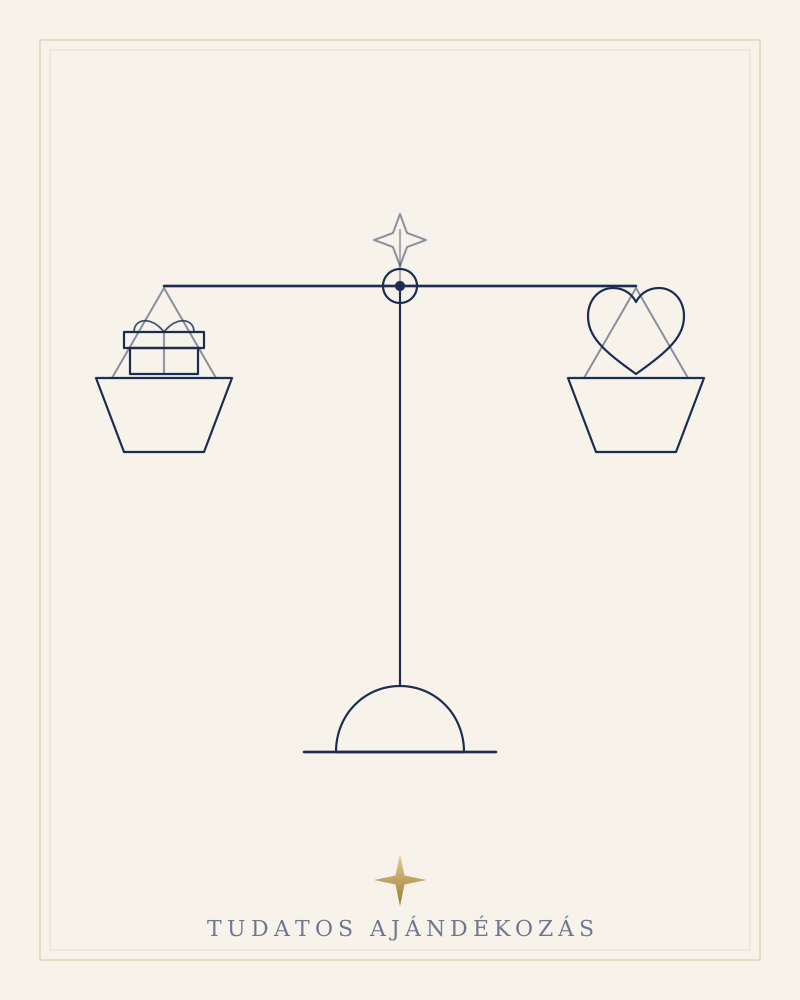
Every home has a drawer. Pens, key rings, notebooks, a thermos or two, a kitchen gadget that never left its box. There's nothing wrong with any of them, and yet there they all are, piled on top of one another, sinking a little deeper every year.
We think this drawer is the most honest feedback on gift-giving we could ever get. It isn't about having received bad gifts. It's about someone lovingly giving something that had no place. In this piece we've gathered what helps us make sure that what we give doesn't end up there.
What does mindful gift-giving mean?
Not going without, and not strict rules. The way we see it: when choosing a gift, we think for a moment about the other person's everyday life, not just the minute of giving. About what the object will do to their home, their time, their attention – and what they will do with it.
Gift-giving tries to do two things at once. We want to show that the other person matters to us, and at the same time we'd like them to actually get some use out of it. The two don't always coincide. When a deadline is looming, the expression usually wins: we buy something that looks lovely in its wrapping and hope for the best. Being mindful simply means not letting go of the second consideration either.
How do you choose a useful gift?
We ask ourselves three questions before deciding:
- Where will this object be in a month's time? If you can picture it on the table, on the shelf, in a coat pocket, you're on the right track. If you can't answer, the drawer is the most likely reply.
- Will it be used up, or kept? Either can be good, but it's worth choosing between them deliberately.
- Do I like it, or do they? This is the hardest question. We often give what we'd like to receive ourselves – a kind gesture, but one that doesn't always hit the mark.
If you have a calm answer to all three, the gift almost always finds its place. If you get stuck on any of them, there's still time to look for something else.
Which is the better gift: something that gets used up, or something that lasts?
Something that gets used up takes up no space and creates no obligation. A good honey, a tea, a cake doesn't ask to be stepped around for years. Something that lasts, on the other hand, really does have to fit into the other person's life – their style, the size of their home, their habits.
We believe the best gift has both: something that gets used up, and something that lasts but takes up no space. In the GALAMBOM box there is a handmade gingerbread made with, among other things, white rye flour, local farmers' blossom honey and cane sugar, and beside it a hidden satin ribbon bearing a single sentence from a Christian saint. The gingerbread gets eaten. The sentence stays – in a wallet, between the pages of a book, or passed on to someone who happens to need it.
The drawer isn't about having received bad gifts. It's about having lovingly given something that had no place.
Can a small gift be a good gift?
Yes, and this distinction matters to us: restraint isn't stinginess. A restrained gift isn't less, just more precise. A small, well-chosen thing usually says more than a big one bought at random at the last minute – because it shows that thought went into it.
It has a quiet advantage, too: a small gift doesn't put the other person in an awkward position. They don't have to wonder how to return the favour, and they don't have to make room for it. With us, a GALAMBOM box costs €4.20, or €4.00 each from ten boxes. It's a scale that suits an everyday kindness as well as a festive one. If you're visiting someone, we've also written separately about the quiet rules of the host gift.
What should you give if you really don't know what they need?
In that case, the most honest answer is to ask. Many people shy away from this, feeling it spoils the surprise. Our experience is the opposite: people are usually glad to discover that you genuinely wanted to give them something good, not just get the gift-giving over with.
If asking isn't possible, two directions remain. One is something that gets used up: something to eat, drink or put by. The other isn't an object but a gesture – time together, a letter, a sentence. We've written more about this in the article that asks what to give someone who has everything.
How can gift-giving leave less rubbish behind?
Besides the drawer, there's another quiet place: the bin bag after the holidays. Sometimes the biggest part of a gift is what gets thrown away two minutes later – a plastic window, several layers of film, a presentation box inside a box.
We try to avoid this with our own packaging: we use FSC cardboard and satin ribbon, with no unnecessary layers. Not because it's fashionable right now, but because we don't want the packaging to be the part of the gift that lasts longest. If you're doing the wrapping, a ribbon and simple paper are often lovelier than any presentation box – and the ribbon can be brought out again next year.
When is it worth starting to choose a gift?
Sooner than you'd think. Choosing mindfully takes time: it's haste that fills the drawer. Anything handmade needs time too – with us, larger orders take two to three weeks, or three with a custom text.
GALAMBOM shipping starts in early November. Within Hungary, delivery to a parcel locker is €3.33, free over €42.00; home delivery is €7.81, free over €84.00; to Austria and Germany it is €22.37. In 2026 the first Sunday of Advent falls on 29 November, so if you're preparing for Christmas, it's best to order by mid-November. On our Occasions page we've gathered the unit prices and deadlines for each occasion.
We think the measure of a good gift isn't how much joy it brings at the moment it's handed over, but where it is a month later. If it's on the kitchen counter, in a coat pocket, between the pages of a book – or already used up, with only a sentence left behind – then it found a good home.
And the drawer stays what it always was: a quiet reminder that gift-giving doesn't begin with shopping, but with attention.
Frequently asked questions
A gift that won’t end up at the bottom of a drawer – how do you choose one?
By being able to picture its place in the other person's life before you hand it over: on the kitchen counter, on the bedside table, in a bag. It helps to ask yourself where the thing will be in a month's time, whether it will be used up or kept, and who really likes it. If you can answer all three with calm confidence, the gift almost always finds its place.
What does mindful gift-giving mean?
It means that when choosing a gift, you think about the other person's everyday life, not just the moment of giving. It isn't about going without or following strict rules – just one more thing to consider: that the gift will genuinely be of use to the person who receives it.
Which is the better gift: something that gets used up, or something that lasts?
Both can be good. Something that gets used up – honey, tea, cake – takes up no space and creates no obligation; something that lasts has to fit into the other person's life. We like a gift to have both, for example a gingerbread and, alongside it, a sentence worth keeping.
Can a small gift be a good gift?
Yes: restraint isn't stinginess, it's precision. A small, well-chosen thing says more than a big one bought at random, and it doesn't put the other person in an awkward position. With us, a GALAMBOM box costs €4.20, or €4.00 each from ten boxes.
What should you give if you really don't know what they need?
The most honest answer is to ask – people are usually glad to discover that you genuinely wanted to give them something good. If that isn't possible, choose something that gets used up, or give a gesture instead of an object: time together, a letter, a sentence.
How can gift-giving leave less rubbish behind?
With simple wrapping: paper, ribbon, no unnecessary layers. We use FSC cardboard and satin ribbon, because we don't want the packaging to be the part of the gift that lasts longest. The ribbon can be brought out again next year.
When should you order your Christmas gifts?
For handmade gifts, by mid-November, because larger orders take two to three weeks, or three with a custom text. GALAMBOM ships from early November; within Hungary, delivery to a parcel locker is €3.33, free over €42.00, and to Austria and Germany €22.37.
 Written by the SpicaHome editorial team. If you have a story you think we should share, write to us – we read every message.