Guide
Why a Christian gift need not be kitsch: the balance of form and content
Many of us have an object like this tucked away at the back of a drawer. A glittery little angel, a picture with an inscription, given lovingly by someone and never put on display. It did not stay in the drawer because of faith. Something about it just felt off, though it would have been hard to say what.
When we began designing our first pieces, this question came back again and again. For a long time we thought it was a matter of taste. Today we think it is not: kitsch has a structure, and once you understand it, you can avoid it.
What exactly does kitsch mean?
The word is German in origin. According to tradition, Kitsch appeared in the second half of the 19th century in the art dealers’ shops of Munich, used for cheap pictures that sold quickly. Its origin is disputed: some link it to a dialect verb meaning “to scrape up mud” or “to daub”, while others consider it a corruption of the English sketch.
Perhaps the sharpest formulation came from the Austrian writer Hermann Broch: in his view, kitsch is not simply bad art, but art that wants to work not “well” but “beautifully”. In other words, it seeks not truth but effect. That is why a simple wooden cross can be dignified, and why a gilded, light-up, musical version can be uncomfortable. It is not the measure of faith that differs, but the proportion.
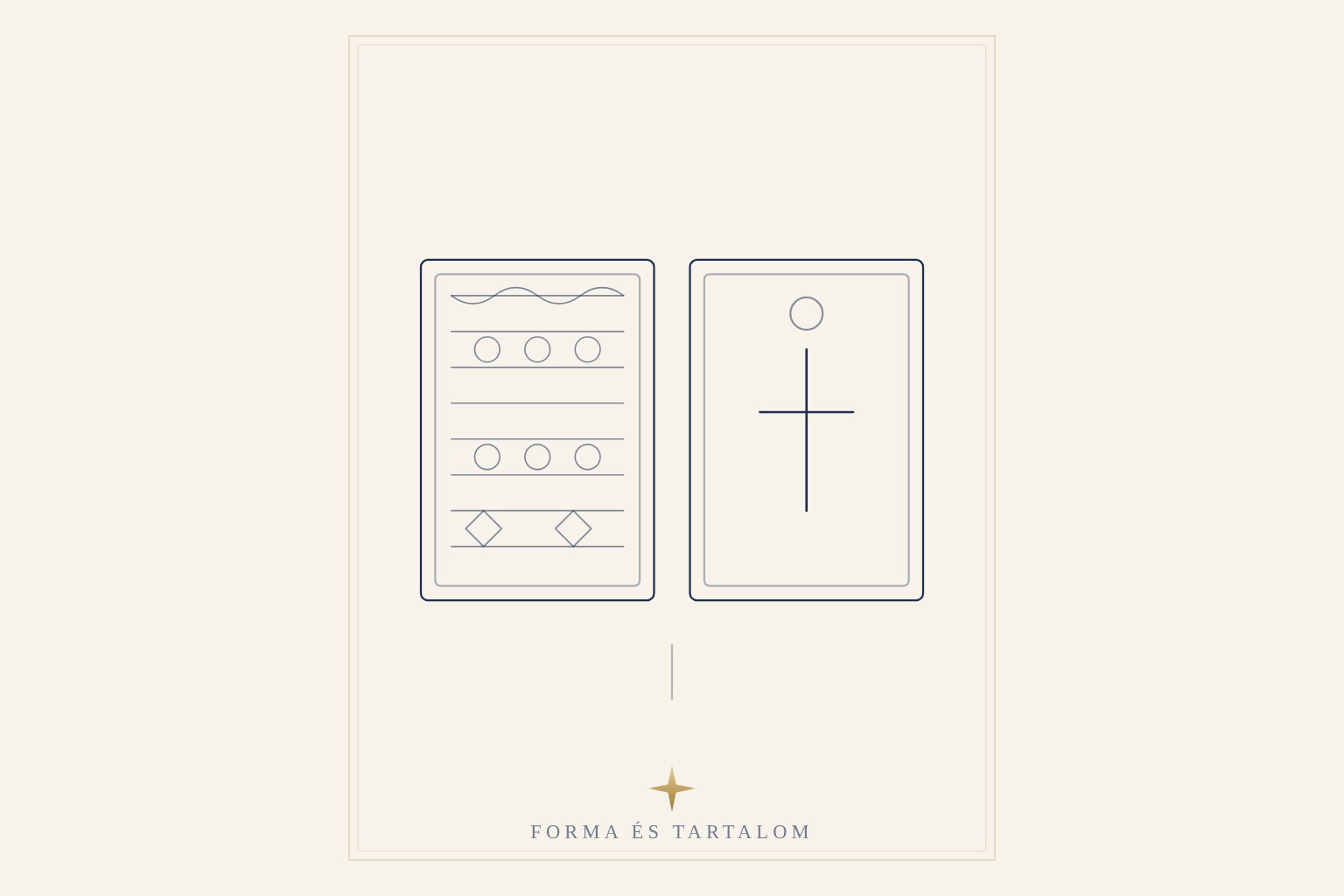
Kitsch is born when the form is louder than the content.
What is the difference between a devotional object and a Christian gift?
According to the Hungarian Catholic Lexicon (Magyar Katolikus Lexikon), a devotional object is something that fosters personal religious devotion: a cross, a crucifix, a holy picture, a statue, a rosary, a scapular. People mostly keep these close and use them in prayer. The lexicon also stresses that a devotional object is not an amulet: we do not attribute power to the object itself.
A Christian gift is broader than that. It may be a devotional object, but it may also be a book, a picture or a small edible treat that carries a thought of faith further. Then the measure is different too: the question is not how “holy” the object is, but whether it is worthy of what it carries.
Can a Christian gift be too restrained?
Yes, and we talk about this less. When someone is so afraid of kitsch that they sand every trace of content off an object, the result is beautiful, minimalist, neutral – and says nothing. This kind of caution is just as empty as ostentation, only quieter.
In our experience, this is the more common mistake with Christian gifts today. We are so keen not to give a devotional object that we end up holding a beautiful design piece with no meaning. Yet anyone who gives a Christian gift wants precisely for something to come across.
What does a tasteful, modern Christian gift look like?
We look for the narrow space between the two, where an object turns respectfully towards tradition yet fits naturally into a home of today. Not surprisingly, the Church thinks along similar lines: writing about sacred art, the Second Vatican Council asked that they “strive after noble beauty rather than mere sumptuous display”.
In practice this means a few decisions. Few elements: one symbol, not five. Restrained colour: deep blue, ivory, a single line of gold. Genuine material: something that looks like what it is. And a message that is not visible at once. In the GALAMBOM box, for example, a satin ribbon is hidden inside; only when it is pulled out does a single thought of a Christian saint become visible. We have twenty-four different messages, and the gingerbread is made by hand at the Milimári Sütiműhely bakery in Budakeszi.
This last point matters most to us. What shouts at once soon tires us. What waits for us to turn towards it stays with us much longer. We sought the same quiet presence when we wrote about the table blessing.
How can you tell whether an object is kitsch?
If you are unsure about an object, ask yourself: could I put it on display in the living room without having to explain it? If yes, it is probably fine. If not, that is not necessarily because of faith, but because the object promises more than it delivers.
A second question helps too: what remains if you take away the decoration? With a good object, something still remains – a form, a sentence, a gesture. With kitsch, almost nothing.
Which occasions suit a Christian gift?
Above all those where faith is present anyway: a christening, First Holy Communion, Confirmation, a wedding, but also a name day or Christmas. On these occasions no one expects the gift to be neutral; what they do expect is that it is not awkward to put on display. We believe that the objects we surround ourselves with also shape our souls. That is why refined form and quality materials matter to us – not as an aesthetic luxury, but because an object can only accompany us through everyday life if it is not tiring to look at.
Frequently asked questions
Where does the word kitsch come from?
From the German word Kitsch, which spread in the art dealers’ shops of Munich in the second half of the 19th century as a term for cheap pictures that sold quickly. Its exact origin is disputed: some link it to a dialect verb meaning to scrape up mud or to daub, others to the English word sketch.
What counts as a devotional object?
According to the Hungarian Catholic Lexicon (Magyar Katolikus Lexikon), it is something that fosters personal religious devotion, such as a cross, a crucifix, a holy picture, a statue, a rosary or a scapular. A devotional object is not an amulet: we do not attribute power to the object; it is an aid to prayer.
Can a Christian gift be modern?
Yes. Modern here does not mean abandoning tradition, but a pared-back form: few elements, restrained colour, genuine material. Such an object can carry a prayer or a saint’s thought just as well – only not loudly.
Can we give a Christian gift to someone who is not a believer?
Yes, as long as the object does not ask them for a profession of faith. A beautiful sentence, a small edible treat of good quality or a pared-back image can speak to anyone. It is worth choosing something that is sincere in its message and tactful in its form.
Why is the message hidden in the GALAMBOM box?
Because we believe that what shouts at once soon tires us. A satin ribbon is hidden in the box, and only when it is pulled out does a single thought of a Christian saint become visible on it. There are twenty-four different messages.
What should we do with a devotional gift that feels kitschy?
It is worth first seeing the intention behind it: whoever gave it most likely gave it out of love. If it does not suit your home, put it somewhere you use it personally, such as your prayer corner, or pass it on to someone it will bring joy to. If the object has been blessed, your parish will gladly advise you too.
 Written by the SpicaHome editorial team. If you have a story you think we should share, write to us – we read every message.