Tradition
The Advent wreath: what the four candles mean
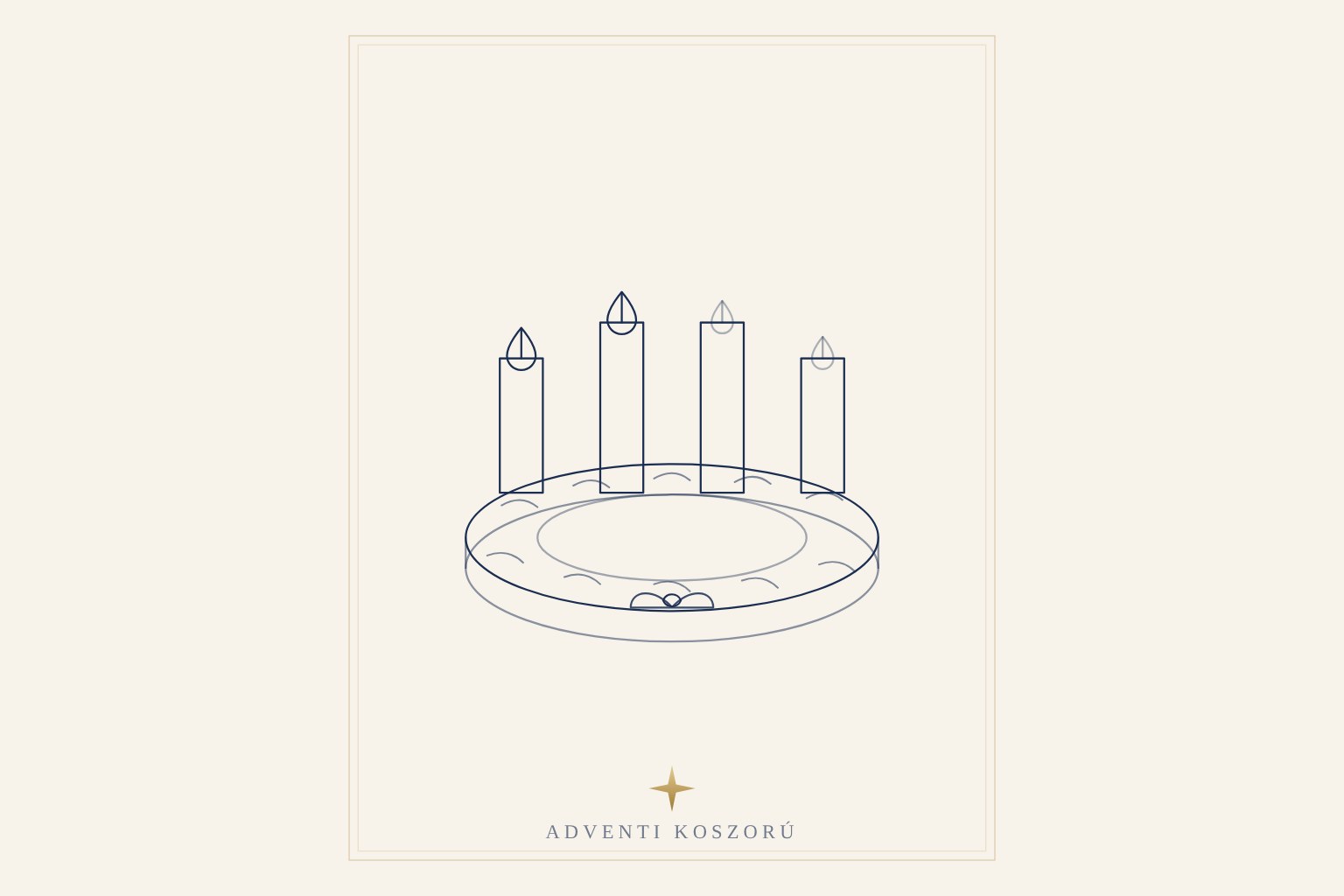
On a Sunday afternoon, when the light is already fading by four o'clock, someone strikes a match and lights just one of the four candles. The other three still stand, untouched. All of Advent is in that single gesture: we have set out, but we are still far away.
The Advent wreath has become such a natural part of December in Hungary that we hardly stop to think how young a custom it is. We think it is worth knowing what its candles say – they give more than one answer, and each of them is beautiful.
Who invented the Advent wreath?
Johann Hinrich Wichern, a Lutheran theologian and founder of the Rauhes Haus in Horn (now part of Hamburg), a home where poor, abandoned children were brought up. Every day in Advent the children asked the same question: how many days until Christmas? In 1839 Wichern made a wooden frame the size of a cartwheel and set candles on it: a small red one for every weekday and a large white one for every Sunday. Each day one more was lit, and by Christmas Eve they were all burning.
People began decorating it with fir branches around 1860. It moved into family homes in a smaller form: over time the weekday candles fell away, and the four Sunday candles remained.
How long has the Advent wreath been around in Hungary?
It reached us much later. In the first half of the 20th century it was seen mostly in middle-class homes; it spread more quickly after the Second World War, and in many places it became a natural sight on every family's table only in the last decades of the century. That takes nothing away from its value: a good custom takes root even when it arrives late.
What do the four candles on the Advent wreath mean?
Two interpretations live side by side, and both have long been widespread. In the best known, the four candles are faith, hope, joy and love. The first Sunday belongs to faith, when the least can yet be seen of what is coming; the fourth belongs to love, when all four flames are already burning.
The other tradition links the candles to people. The first recalls Adam and Eve, to whom God first promised redemption. The second recalls the chosen people – in other accounts, the prophets – to whom he promised the coming of the Messiah. The third and fourth belong to St John the Baptist, who prepared the way, and to the Virgin Mary; the order of these two differs from source to source. Neither interpretation is a binding rule; it is tradition that has kept them. Feel free to choose the one that means more to your family.
The wreath does not hurry us. One candle a week, it shows that the light does not arrive all at once, but step by step.
Why is the third Advent candle pink?
Purple is the liturgical colour of Advent, the colour of penance and expectation. The third Sunday of Advent, however, is an exception: its name comes from the Latin opening chant of the Mass, which quotes St Paul's Letter to the Philippians: Gaudete in Domino semper, “Rejoice in the Lord always”. On this day the priest may wear rose-coloured vestments, and on the wreath, too, the pink candle is lit. It shows that, halfway through the waiting, joy is already near.
In 2026 Gaudete Sunday falls on 13 December, St Lucy's Day. In other denominations and in many families, the wreath simply holds four matching candles – purple, red or white. That is not wrong either: the colours come from the liturgy, but the wreath is a custom of the home.
When do we light the Advent candles in 2026?
The first Sunday of Advent is always the Sunday closest to St Andrew's Day, 30 November, so it falls between 27 November and 3 December. In 2026 that is 29 November. The second candle is lit on 6 December, which is also St Nicholas' Day; the third, pink one on 13 December, and the fourth on 20 December. This year Christmas Eve falls on a Thursday and Christmas Day on a Friday.
Many families light the next candle on Sunday, others on Saturday evening. The exact time matters less than keeping it the same: a custom is kept alive by repetition, not by ceremony. Some wreaths also have a fifth, white candle in the middle, known as the Christ candle – it is lit on Christmas Eve.
What can go alongside the wreath for the weekdays?
Wichern's little red candles counted the weekdays – today that role is played by the Advent calendar, which we have written about separately. For us, this became the Advent package: twenty-four GALAMBOM boxes, one for each day from 1 December to Christmas Eve. Each holds a handmade gingerbread and a hidden satin ribbon; pull it out and a single thought from a Christian saint is revealed. Each one can also be hung on the tree.
The package costs €92.12, which works out at €3.84 per box. We ship it from early November so that it arrives by the first Sunday of Advent, 29 November. The wreath keeps the Sundays, the calendar the weekdays. You will find our other ideas gathered on our Christmas gifts page.
Frequently asked questions
Who made the first Advent wreath?
Johann Hinrich Wichern, the Lutheran theologian who founded the Rauhes Haus children's home in Hamburg, in 1839. On a wooden frame the size of a cartwheel he placed small red candles for the weekdays and large white ones for the Sundays, and each day one more was lit. People began decorating it with fir branches around 1860.
Why are Advent candles purple?
Purple is the liturgical colour of Advent, the colour of penance and expectation. That is why, in Hungarian Catholic practice, the wreath holds three purple candles and a fourth that is pink. In many families and in other denominations, four matching candles burn – purple, red or white – and that is not wrong either.
On which Sunday do we light the pink candle?
On the third Sunday of Advent, called Gaudete Sunday after the Latin opening chant of the Mass, “Gaudete”, meaning “Rejoice”. In 2026 it falls on 13 December. The pink shows that, halfway through the waiting, joy is already near.
When is the first Sunday of Advent in 2026?
On 29 November. The first Sunday of Advent is always the Sunday closest to St Andrew's Day, 30 November, so it falls between 27 November and 3 December. In 2026 the remaining Sundays of Advent are 6, 13 and 20 December.
Should the Advent candle be lit on Saturday evening or on Sunday?
Both are common: many families light the next candle on Sunday, others on Saturday evening. What matters is that it happens at the same time each week, ideally together, and that each time one more candle is burning.
What does the fifth, white candle in the middle of the wreath mean?
Some wreaths have a fifth, white candle alongside the four, known as the Christ candle. It is lit on Christmas Eve, 24 December, and symbolises the birth of Christ.
 Written by the SpicaHome editorial team. If you have a story you think we should share, write to us – we read every message.